Forehead contouring surgery
The term contouring means shaping and altering form, and today it is used for many parts of the body. The ultimate goal of contouring is to correct imperfections and establish aesthetic standards in a specific area of the body. In recent years, with advances in technology and the expansion of forehead surgeries, forehead contouring has become widely and very precisely achievable.
Forehead contouring (or forehead shaping) refers to a set of procedures in which the shape and dimensions of the forehead are altered either realistically or visually (for example, by creating optical illusions). For forehead contouring, cosmetic and non surgical methods have been used for more than several decades. The aim of this article is not to review non surgical forehead contouring methods; rather, our goal is to discuss which surgical methods can be used in cases where individuals have not achieved their desired forehead contouring results through non surgical approaches.
The main imperfections that lead individuals to seek forehead contouring are as follows:
Prominence of the upper forehead (frontal bossing)
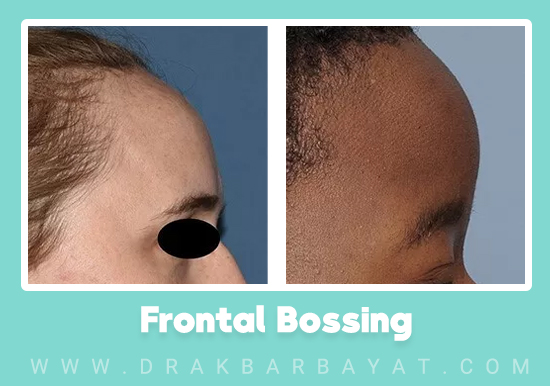
In some individuals, the upper part of the frontal bone protrudes forward, creating an unattractive appearance. In very severe cases, the prominent area extends even further forward than the lower parts, namely the eyebrows (top right image), and is often associated with a high forehead (a large distance between the eyebrows and the hairline). Interestingly, this type of prominence is seen more frequently in women than in men, and its cause can be attributed to the individual’s genetics. The growth of this part of the forehead has no relationship to the development of the frontal sinuses. Although, at the time of writing, no definitive method has been found to prevent the occurrence of this type of deformity, fortunately there are ways to correct it.
Many women who suffer from this condition have, through experience, learned to use their hair to conceal this part of the forehead.
In forehead contouring surgery, in addition to reducing the degree of forehead prominence, associated issues such as an excessively high forehead (a distance of more than 5 to 6 cm from the eyebrows to the hairline) can also be corrected, and the forehead can be shortened.
Contact us via WhatsApp for offline consultation.
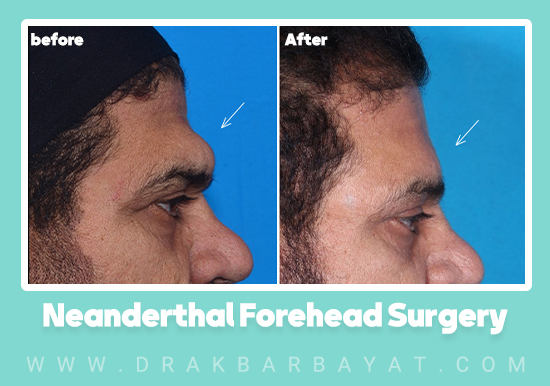
Lower forehead prominence (Neanderthal forehead)
Unlike upper forehead prominence, which is more common in women, lower forehead prominence is a common finding in men.
Mild cases of lower forehead prominence do not require correction; however, more pronounced protrusions can give a man’s face a harsh or rugged appearance. In women, even a slight degree of lower forehead prominence can significantly reduce facial delicacy and make the face appear masculine.

In summary, the following individuals are suitable candidates for surgical correction of lower forehead prominence as part of forehead contouring:
● Women who wish to soften and feminize their facial features
● Individuals seeking male to female gender transition
● Men whose excessive lower forehead prominence has made their facial appearance harsh and unbalanced.
Prominent orbital rim (infra brow bone prominence)
Prominence of the bone beneath the eyebrow, or the orbital rim, in most individuals appears as a continuation of lower forehead prominence. The difference is that this prominence extends laterally to the side portions of the orbital rim as well. Therefore, in most patients undergoing forehead contouring surgery, this prominence is corrected simultaneously with lower forehead prominence.
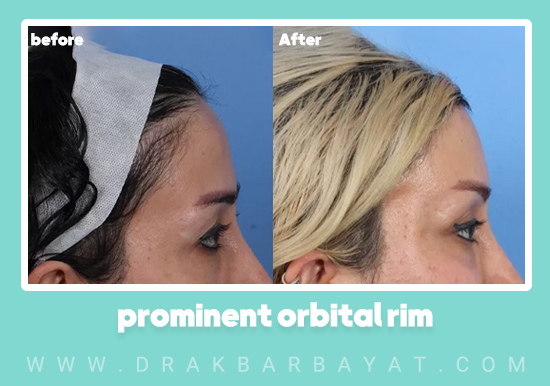
In some cases, prominence of the bone beneath the eyebrow occurs independently. In such situations, it can be corrected using other methods, such as upper eyelid surgery, without the need for forehead contouring.
[elementor template id=”2299″]
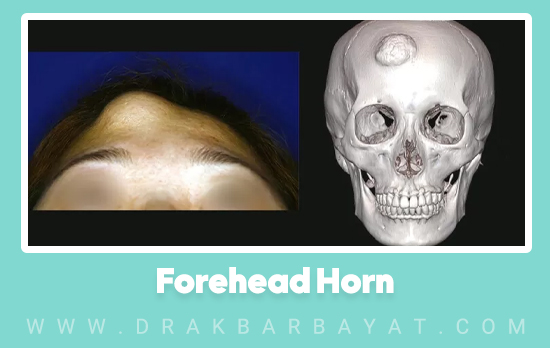
The term forehead horn is unfamiliar to many people and even to many physicians. However, individuals who have this condition are often aware of it and, despite being dissatisfied with its appearance, do not know which specialist they should consult for correction. Forehead horns refer to small, button like prominences that appear on both sides of the central part of the forehead in some individuals.
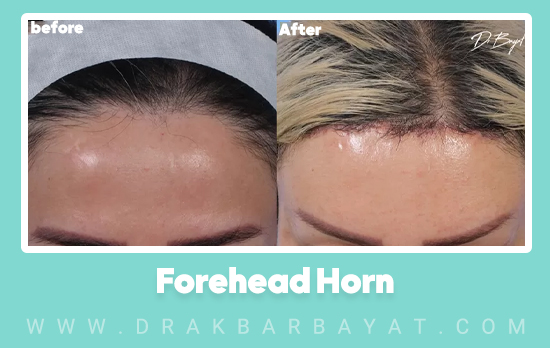
These forehead prominences are normal and should not be confused with bone tumors of the forehead. Therefore, their removal is purely for cosmetic purposes. Occasionally, benign bone tumors can also cause protrusions in the forehead area, but a skilled physician can easily distinguish a tumor related prominence from a forehead horn. In most cases, surgical removal of these tumors is the only treatment.
Changing forehead dimensions
Sometimes, in certain individuals, a mismatch in the size and dimensions of the forehead relative to other facial features can cause aesthetic disharmony. For example, while a forehead length of 7 cm in a man with large facial features may appear completely proportionate, in a woman with a delicate face, a forehead length of 5 to 6 cm can easily create disharmony, to the extent that correction may be needed.
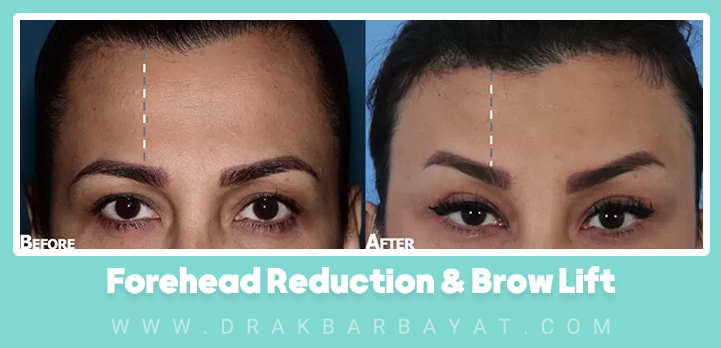
Although non surgical methods can alter the dimensions of the forehead, particularly by creating optical illusions, forehead contouring allows us to physically shorten the forehead by advancing the hairline. Using a similar approach combined with bone shaving, we can also reduce the width of the forehead. Changing forehead dimensions is not limited to making it smaller; in some cases, increasing the forehead size may be necessary to achieve facial harmony.
Contact us for consultation
Correction of deformities after trauma and accidents
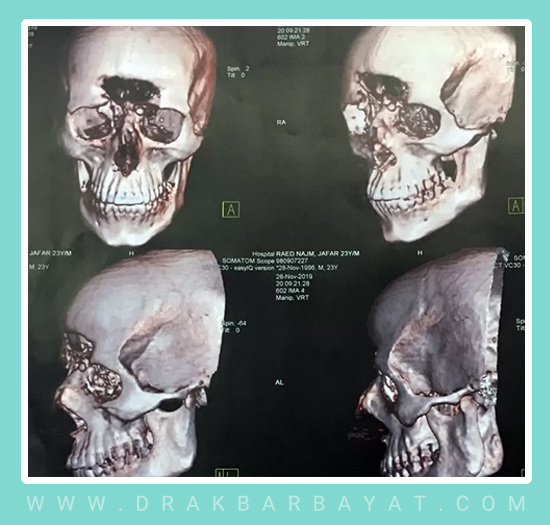
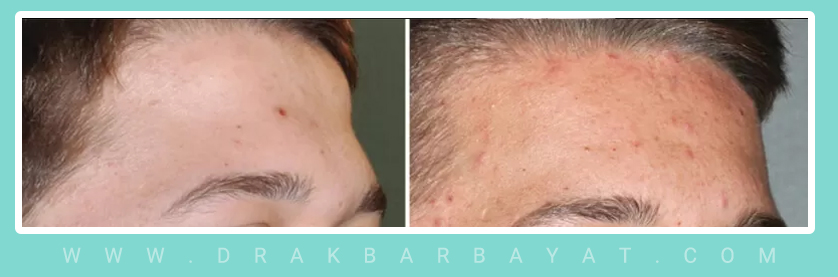
In some individuals, previous trauma can cause deformities in the forehead. Since the forehead is always visible, these deformities can have a significant negative impact on a person’s appearance. To correct these deformities, it is important to determine whether the defect involves soft tissue or hard tissue. As shown in the image below, soft tissue defects usually appear in the form of scars.
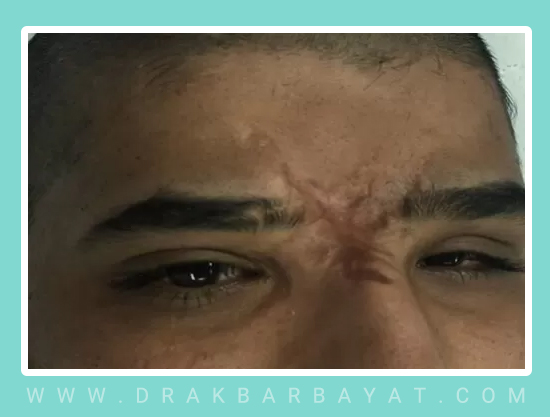
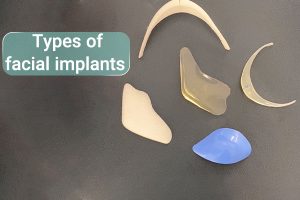
In fractures of the frontal bone, the issue is more complex than simply repairing the soft tissue. Sometimes, bone shaving, bone grafting, the use of implants, and other techniques are required to correct the bony defect.
Forehead feminization surgery
Because the shape of the male and female forehead generally differs, the forehead is one of the most important facial areas for determining a person’s perceived gender. In individuals undergoing male to female gender transition, forehead feminization constitutes a major part of the overall facial transformation.
How is forehead contouring surgery performed?
For clarification, consider the following example:
The surgeon may choose either an endoscopic or an open approach for forehead contouring. Incisions for either method can be made within the hairline or at the front of the hair. Generally, the most significant changes in forehead contouring can be achieved with an open incision, especially at the front of the hairline. However, if a patient presents with a very short forehead (e.g., 4 cm), a front hairline incision is not recommended. In such cases, an endoscopic approach or an open incision within the hairline will produce a better result.
Dr. Akbar Bayat
Board certified facial plastic surgeon from Europe