Types of Facial Prostheses
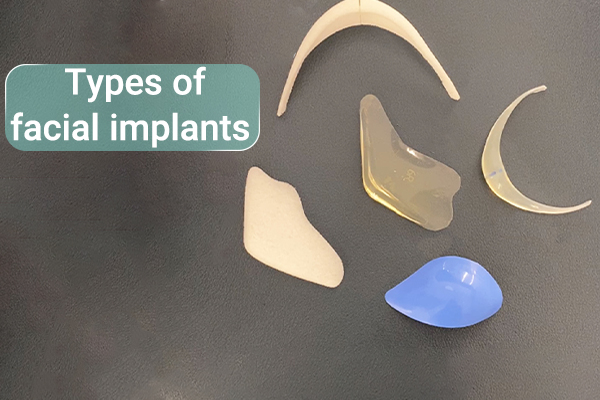
One of the common methods in facial cosmetic surgery is the use of various prostheses to enhance certain areas of the face. Different types of prostheses have been designed for various parts of the face and are available on the market. In most cases, these prostheses are used to augment and enlarge specific facial features. However, in certain cases, facial prostheses can also be used for reconstruction or symmetry purposes.
The figure below shows the different areas of the face where prostheses can be used for augmentation.

Characteristics of a Good Prosthesis
The biocompatibility of the prosthesis material with the body is one of the most important criteria for a good prosthesis, and this compatibility must be such that it does not trigger any unwanted reactions in the body. On the other hand, the consistency (firmness) of the prosthesis should closely match the tissue it is intended to augment. For example, a lip prosthesis should be very soft, whereas a prosthesis placed over bone should have a firmer consistency.
The proper shape and size of the prosthesis are determined during the preoperative consultation.
Suitable Areas of the Face for Prostheses
One of the best indications for using a facial prosthesis is when insufficient bone growth leads to facial deficiencies, such as underdeveloped or small chin or cheek bones.
The most common area for augmentation with a prosthesis is the chin. Many individuals with a small chin achieve a significant improvement in facial aesthetics by augmenting this area. Cheek augmentation with prostheses is the second most common use after the chin.
While augmentation of the chin and cheeks is well known, it should not be forgotten that enhancing other areas of the face, such as the jaw angle, can also have a significant impact on facial aesthetics in suitable candidates. In such cases, a preoperative consultation is highly helpful.
In most cases, facial prostheses are placed over bone. In these situations, special screws can be used to attach the prosthesis to the bone, minimizing the risk of displacement.
Sometimes prostheses are also used in soft tissues, such as the lips. In these cases, due to the prosthesis being palpable and affecting lip movement, some patients may be less satisfied with the results. On the other hand, some individuals are pleased with the results because the lips gain significant volume.
Contact us via WhatsApp for offline consultation.
Complications of Facial Prostheses
Asymmetry after prosthesis placement is one of the most common complications following surgery. In most cases, this asymmetry is minimal and does not require correction. Major factors contributing to facial asymmetry include improper fixation of the prosthesis during surgery or trauma after the procedure.
Another possible complication is numbness in the areas surrounding the prosthesis. Fortunately, in most cases, this numbness is mild and typically improves over time.
Since a prosthesis is considered a foreign body, the body cannot protect it against microbes as it does with its own tissues. Therefore, theoretically, all implanted prostheses carry a risk of infection. However, some prostheses, such as Medpor implants, are more biocompatible and porous, allowing tissue ingrowth and better integration with the body. Overall, the risk of infection with facial prostheses is less than 1%.
Is Facial Prosthesis Also Used for Facial Rejuvenation?
Is it Better to Use the Body’s Own Tissues Instead of Prostheses for Facial Augmentation?
Indeed, one way to augment the face for example, to enhance the cheeks is by using the patient’s own tissues. Bone, cartilage, or soft tissue can be harvested from one part of the body and used to augment another area. A major advantage of this approach is that the risk of surgical site infection is lower compared to using facial prostheses. However, this method requires harvesting bone or cartilage from another site, which increases the duration of surgery and prolongs the postoperative recovery period.
Fortunately, the use of prostheses significantly reduces surgical time. Considering that modern prostheses are highly biocompatible and have a very low risk of infection, facial prostheses have become the globally accepted standard for skeletal facial augmentation.
Contact us via WhatsApp for offline consultation.
Biocompatibility of Prostheses
The body’s reaction to different prostheses varies. In silicone prostheses, which are widely used, the body responds by forming a fibrous capsule around the implant. This capsule helps to somewhat stabilize the prosthesis and prevent excessive movement.
Medpor prostheses, on the other hand, have higher biocompatibility, allowing body tissues to grow into the small pores of the implant. This tissue ingrowth significantly reduces the risk of infection. In some cases, Medpor prostheses function almost like natural bone, providing excellent contour and shape to the augmented area.
Silicone Prostheses
Silicone prostheses are among the oldest types of facial implants, with proven biocompatibility (their use dates back over 100 years). Major advantages of silicone implants include low cost, softness, and ease of removal by a plastic surgeon.
However, some disadvantages exist. When placed over bone, silicone implants may cause mild resorption of the underlying bone over time, though this usually does not significantly affect the final surgical outcome. Additionally, the fibrous capsule formed around the silicone implant is not very strong and may not fully prevent prosthesis displacement. For this reason, many surgeons prefer additional secure fixation methods to ensure the implant remains stable.
Medpor Prostheses
Medpor prostheses, or porous polyethylene implants, unlike silicone, have a firmer consistency. This characteristic allows them to behave more like natural bone when placed over the skeletal structure. Medpor implants do not cause resorption of the underlying bone, and their porous nature enhances biocompatibility. Tissue ingrowth into the pores helps anchor the implant firmly to the surrounding area, reducing the risk of displacement. However, this same feature makes removal more challenging, so the placement and use of Medpor implants should only be performed by highly experienced plastic surgeons.
Gore Tex Prostheses
Gore Tex prostheses, or polytetrafluoroethylene implants, are also porous and allow tissue ingrowth. They are somewhat softer than Medpor implants. In most cases, screws or sutures are used to secure them to the surrounding tissues.
Contact us for consultation
Prosthesis Placement
Most facial prostheses can be placed intraorally (through the mouth). Although some surgeons believe that this approach may increase the risk of postoperative infection, statistical evidence shows that placing a prosthesis via the oral route does not significantly affect the risk of infection. The main advantage of the intraoral approach is that it leaves no visible surgical scars.
Another method is the extraoral (through the skin) approach. In this technique, the surgeon reaches the implant site via an incision made on the skin. Fortunately, these incisions are placed in inconspicuous locations, such as under the chin, or in areas where no visible scar remains after healing, such as along the eyelid margin. A significant advantage of the extraoral approach is that it allows simultaneous aesthetic procedures.For example, in a patient with excess fat under the chin (double chin), the submental incision can be used both to place the prosthesis and to correct the double chin.
Ultimately, the choice between intraoral and extraoral placement depends on the surgeon’s recommendation and the patient’s preference, usually discussed during the preoperative cosmetic consultation.
Should the Prosthesis Be Fixed with Screws?
Fixing the prosthesis with special screws offers several advantages. First, it reduces the risk of prosthesis displacement. Second, it eliminates any gap between the prosthesis and the underlying bone. When a gap exists, it can lead to over augmentation of the target area. For example, if the chin is intended to be advanced by 6 mm and there is a 2 mm gap between the prosthesis and the bone, the total projection will be 8 mm, which may cause patient dissatisfaction.
One drawback of screw fixation is that if the result is unsatisfactory, removing a screwed prosthesis can be more time consuming. Overall, the method of fixation should be chosen based on the surgeon’s recommendation and sometimes in agreement with the patient.
Chin Prosthesis Projection
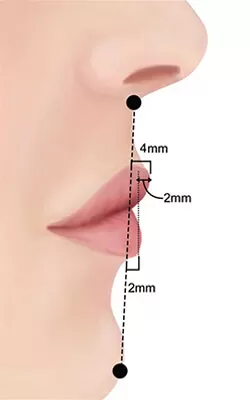
As shown in the figure below, if a line is drawn from the tip of the nose to the chin, it passes approximately 4 mm behind the upper lip and about 2 mm behind the lower lip. In cases of a retruded chin, by drawing a line at these distances from the lips, the area to which the chin can be projected can be determined.
Nowadays, with the help of available software, the placement of certain prostheses can be simulated, allowing for more precise determination of the appropriate prosthesis size.
Dr. Akbar Bayat
Board Certified Facial Plastic Surgeon Europe