Rhinoplasty or facial rejuvenation? Which has priority for people over 45?
In this article:
As we age, the human face undergoes changes that alter our perception of beauty. One of the most common questions among individuals over the age of 45 seeking aesthetic procedures is: Should rhinoplasty be performed first, or is it more important to focus on facial rejuvenation?
To answer this question accurately, we must first understand the facial changes that occur during the aging process and how they affect the appearance of the nose.
Why does the nose appear larger with age?
In the natural aging process, the soft tissues of the face including fat, muscles, and even bone undergo atrophy and resorption. This loss of volume is more noticeable in areas surrounding the nose, such as the cheeks and nasolabial folds. As a result:
● The face appears thinner, flatter, and more sagging.
● The tissues alongside the nose are pulled downward.
● The nasolabial folds become deeper.
● And the nose appears more prominent and larger compared to the other, volume depleted facial features while in reality, there has been no significant change in the actual size of the nose.
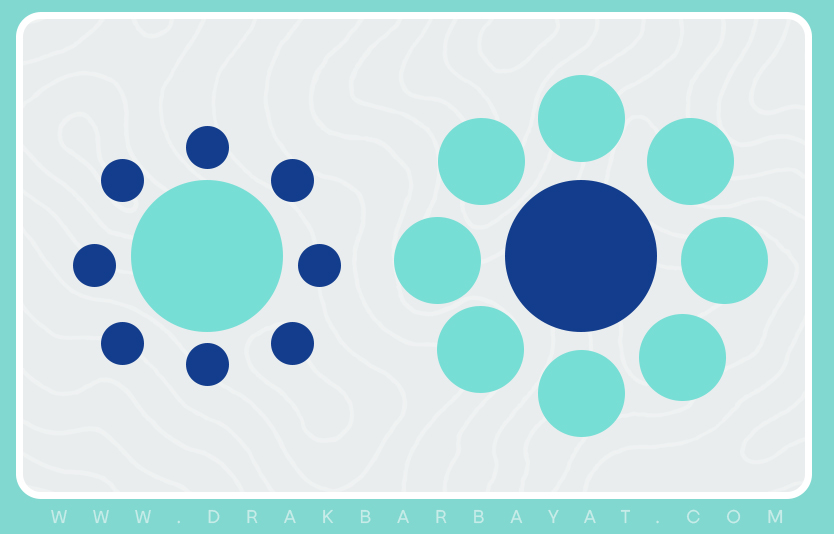
Visual example:
Look at two identical circles in the image below. The circle placed among smaller circles appears larger. This visual illusion clearly illustrates why the nose seems bigger in an aged, volume depleted face.
Therefore, a nose that looked perfectly proportionate in youth may appear large and unbalanced in middle age and later years. In such cases, the main issue lies not in the nose itself, but in the loss of volume and sagging of other areas of the face.
Changes in the appearance of the nose with aging
Like other parts of the face, the nose also undergoes changes as we age. The most important age related changes of the nose include:
● Weakening of the nasal cartilage;
● Drooping of the nasal tip due to reduced structural support;
● A relative increase in nasal length as a result of tip descent;
● Thinning of the skin and increased wrinkling around the nose.
In fact, one of the most noticeable signs of facial aging is drooping of the nasal tip, which can give the face an imbalanced and less attractive appearance.
The role of facial harmony in the perception of nasal beauty
A beautiful, youthful face is not defined solely by a symmetrical and well shaped nose. Rather, what truly enhances facial beauty in youth is the balance and proportion among all facial features. The eyes, eyebrows, cheeks, lips, nose, and jawline must exist in harmony with one another.
When this harmony is disrupted with age and only rhinoplasty is performed, the result may be unsatisfactory or even appear unnatural. A beautiful nose set within a thin, sagging, and heavily wrinkled face not only fails to enhance overall attractiveness, but may actually accentuate facial imbalance.
A practical analogy:
A beautiful nose on an aged face is like a gemstone set in a rusted ring visible, but not radiant.
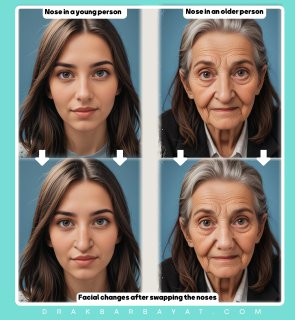
Which should be done first: rhinoplasty or facial rejuvenation?
Considering the extensive changes that occur in the face with aging, facial rejuvenation usually takes priority over cosmetic rhinoplasty. In individuals over the age of 45, the initial focus should be on restoring volume loss, correcting sagging tissues, and reestablishing the overall facial structure. These measures may include:
● Facelift procedures to address tissue sagging;
● Midface lift to elevate the cheeks and improve the contour around the nose;
● Fat grafting or filler injections to restore volume in sunken areas;
● Forehead lift or brow lift to rejuvenate the upper third of the face;
● Treatment of soft tissue atrophy using regenerative techniques or fat transfer.
After the overall facial form has been restored and a more youthful appearance achieved, rhinoplasty if still needed can be performed as a complementary step to create a more harmonious face. This sequence is more logical and aesthetically effective.
Is there a way to make limited corrections to the nasal tip in older individuals?
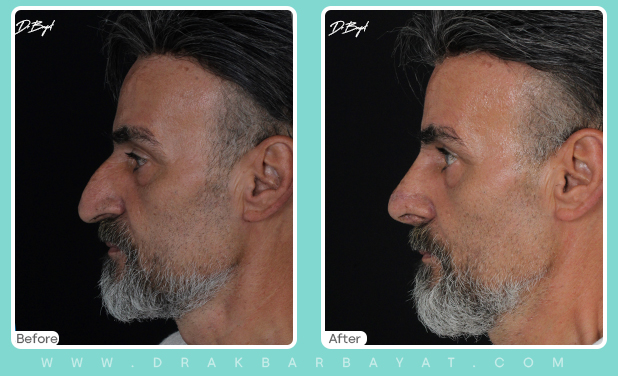
Many older individuals prefer to make only subtle changes to their appearance using the least invasive methods possible. Since nasal cartilages tend to weaken and the skin becomes thinner with age, limited nasal tip correction can be a suitable option for this group.
In such cases, it is possible to:
● Correct drooping of the nasal tip;
● Reduce or rebalance the volume of the nasal tip;
without the need for general anesthesia using local anesthesia instead and with a relatively short recovery period.
Conclusion:
Aging is accompanied by tissue atrophy and facial sagging, which can cause the nose to appear larger than before even if its actual size has not changed. At this stage of life, it is generally better to first focus on restoring the youthful structure of the face and then, if necessary, proceed with nasal correction.
Therefore, if you are approaching the age of 50 or older and are seeking to improve your appearance, it is recommended that you:
Consult about facial rejuvenation methods first;
And after facial rejuvenation, decide on rhinoplasty if needed, in order to achieve the best results, the most natural appearance, and the greatest facial harmony.
This sequence is not only more logical, but it also has a significant impact on overall satisfaction with aesthetic outcomes.
Dr. Akbar Bayat
European Board Certified Facial Plastic Surgeon