Injection of facial and lip fillers is commonly used for facial rejuvenation and the reduction of wrinkles. Unfortunately, due to the nature of these fillers and the methods of injection and application, their use can be associated with certain risks and side effects that have affected many individuals undergoing this type of treatment. To properly understand and become familiar with these complications and their management, it is first necessary to identify the different types of fillers and their generations. In this article, we will discuss the various types of fillers and the generations to which they belong.
We will also examine the characteristics of each type and generation of filler, as well as the differences between them. Dr. Bayat, the head of the surgical team at Limon Beauty Centre, has classified these fillers into four categories, from first and second generation fillers to fourth generation fillers. This classification applies to the fillers that are used in Iran.
Silicone Fillers
Silicone fillers do not fall into the above classification because they were not widely used in Iran. These fillers were invented and used before polyacrylamide (PAAG) fillers. Fortunately, this type of filler never became common in Iran, mainly because the cost of injection was very high, and there was little public acceptance. Most individuals who visit Limon Beauty Centre for the treatment of complications related to silicone fillers are from other countries, where these fillers were used more extensively.
Silicone fillers were commonly injected more than 20 years ago. Due to the high rate of complications and adverse effects associated with them, their use was eventually discontinued.
PAAG Fillers
These fillers are divided into two categories:
First generation PAAG fillers
Second generation PAAG fillers
1. First Generation PAAG Fillers:
Firs generation PAAG fillers do not fully integrate into the tissue. Instead, they remain confined to the area of injection, where simple cysts form around them. These cysts stay localized in the same region. Due to the body’s immune response and the secretions that enter the cysts in an attempt to detoxify and neutralize the filler, the cysts gradually increase in size over time. For example, if a person initially received a 3 cc injection of filler, later on when large cysts had formed we would sometimes drain up to 8 cc of combined secretions and filler material.
If these cysts are subjected to trauma or pressure, they can spread within the face. Typically, the cysts are connected to one another through small channels. To illustrate, imagine a bag of water: when it is struck, the water disperses. Unfortunately, in some cases, facial massage or accidental trauma caused these cysts to spread. Because of the connections between the cysts, their contents and secretions could move into adjacent cysts. As a result, the PAAG filler would migrate within the face, leading to deformities and severe aesthetic complications. Consequently, the face would lose its natural, standard, and attractive contour.
2. Second Generation PAAG Fillers:
The next group of fillers to be introduced were second generation PAAG fillers. These fillers had certain differences compared to first generation PAAG fillers. The main difference was that they were able to adhere to body tissues and integrate into the surrounding tissues. As a result, cyst formation no longer occurred.Instead of remaining localized, these fillers dispersed among the tissue layers, which prevented the development of simple cysts. Because of this increased adhesion to the tissues, the movement and migration of the filler within the face were significantly reduced.
3.Second generation PAAG fillers entered the market several years after first generation
PAAG fillers, and their commercial names were changed. For example, Aquamid is considered a second generation PAAG filler. Unfortunately, many practitioners have told our patients that they received Aquamid and that the injected material was not PAAG, which is incorrect. Aquamid is, in fact, a second generation PAAG filler and, in many cases, is even more problematic than first generation PAAG fillers.
This is because the removal of first generation PAAG fillers is generally easier and causes less discomfort for patients. First generation PAAG filler can be removed relatively easily by making a small incision in the cyst and expressing the filler through massage. In contrast, due to the greater tissue adhesion of second generation PAAG fillers, their removal is far more difficult and can not be performed as simply as the removal of first generation PAAG fillers.
Characteristics of Second Generation PAAG Fillers
1. They adhere to the surrounding tissues.
2. .Due to their tissue adhesion, cyst formation does not occur.
3. They cause inflammation and swelling in the face.
4. They lead to skin discolouration, often turning the skin only a purplish colour.
5. Their removal is accompanied by bleeding.
Important Considerations for Physicians in Treating Complications of Second Generation PAAG Fillers
It is essential for the treating physician to know exactly where the filler is located within the facial tissues, which removal technique should be used, how to control bleeding, and how to precisely evacuate the affected area. The removal of second generation PAAG fillers is not at all similar to the removal of first generation PAAG fillers; it is not a simple matter of making a small incision in a cyst and expressing the filler.
The physician must have a high level of experience and expertise to avoid damage to surrounding tissues. Special care must be taken to protect critical structures such as nerves, muscles, and blood vessels during the removal process. Therefore, it is extremely important to exercise the utmost care when choosing your treating physician.
3.What Are Third Generation Fillers?
Third generation fillers are designed to stimulate collagen production and increase tissue volume, and this is how they were introduced to the market. In fact, these fillers contain substances that are gradually broken down and absorbed by the body. Collagen itself has different types; some types are beneficial, while others may be less suitable. The treating physician must pay close attention to the type of collagen that is produced.
For example, the collagen found in tendons and ligaments is firmer and lacks the elasticity and softness seen in vascular tissues that have pulsation. Essentially, third generation fillers work by stimulating the tissues and inducing certain changes that lead to volumization.
Contact us via WhatsApp for offline consultation.
Is Volumizing Tissues Through Collagen Stimulation a Smart Approach?
It is certainly not an ideal or intelligent approach. When collagen stimulating fillers are injected, only the specific area of the face where the injection is performed enlarges. For example, the lips have a natural shape and contour. In some individuals, the central part of the lip is naturally fuller than the sides. However, when third generation fillers are injected into the lips, they tend to enlarge all areas uniformly, resulting in a “sausage like” appearance. This outcome lacks aesthetic appeal. Individuals who have used third generation fillers in their lips often end up with lips that have no natural contour only increased volume.
Characteristics and Complications of Third Generation Fillers
The filler itself is not inherently problematic; rather, the complications arise from its effects specifically, excessive enlargement of the injected area.
When removing this type of filler, extreme care must be taken to avoid damaging the fibrous tissues that have formed. At Limon Beauty Center, non surgical methods are initially used to address this issue, such as localized corticosteroid injections at varying doses, to reduce the excess lip volume. If these methods are not effective, surgical intervention is then considered.
Corticosteroids help reduce the hardness of areas affected by third generation filler injections and can decrease some of the excess volume that has developed. However, corticosteroids themselves do not act in a targeted or “intelligent” manner. They may soften the injected area, but they may not significantly reduce the volume. Ultimately, the surgeon may be forced to remove a portion of the lip tissue surgically.
Contact us for consultation
4. Fourth Generation Fillers (Hyaluronic Acid)
Hyaluronic acid fillers are considered the safest type of dermal fillers. Fourth generation fillers may still cause side effects; however, the most significant complications have been observed in individuals who used so called “cost effective” or economical fillers particularly low quality, inexpensive Chinese products. Due to their impurities, these fillers have caused facial damage in many cases.
Complications of Fourth Generation Fillers
Fourth generation fillers can be associated with various complications. These fillers may be produced from bacterial sources or through different manufacturing methods. Cheaper fillers are typically made using weaker technologies, which results in a higher level of impurities. These impurities can act as foreign bodies within the body. The immune system recognizes these foreign substances as toxic and reacts against them.
Hyaluronic acid itself is a substance that naturally exists in the human body, and therefore the body does not react to it. However, the question remains: in what ways do these reactions occur?
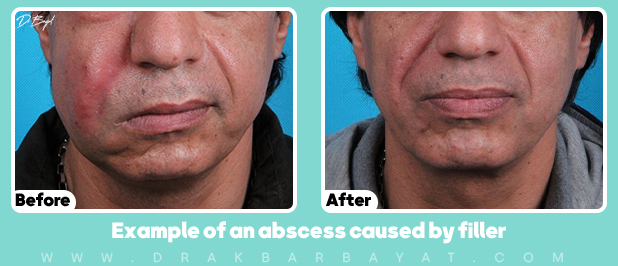
answer this question, the reactions may appear as inflammation and redness at the injection site, periodic swelling, pain, and in some cases, infection. Unlike PAAG fillers, fourth generation fillers do not form cysts, and their treatment is not as difficult as second generation fillers; however, they can still cause irregularities in the surrounding healthy tissue.
At Limon Beauty Center, the first step in treating complications from fourth generation fillers or hyaluronic acid is enzyme injection to break down the hyaluronic acid present in the tissue. Surgery is not the initial step; medication based treatment is prioritized first.
Ultrasound imaging can reveal certain signs that help differentiate between various types of fillers. Occasionally, some of our colleagues mistakenly identify third generation fillers as silicone fillers on ultrasound. The imaging signs of first , second , and fourth generation fillers are often quite similar.
Conclusion
In this article, we discussed the different generations of fillers and their characteristics. Limon Beauty Center is one of the few centers with the expertise required to treat filler related complications and utilizes the latest methods for managing the side effects of facial and lip filler injections. We hope this article has been informative and useful for you.
Dr. Akbar Bayat
Board Certified Facial Plastic Surgeon (Europe)