Cleft lip
When the upper lip does not develop properly during the fetal period, one or two clefts may be seen in the upper lip after birth, as shown in the image below. A cleft lip can be very mild and unilateral, appearing as a slight indentation in the upper lip. On the other hand, it can be very severe, with the cleft extending under and even into the nasal cavity.
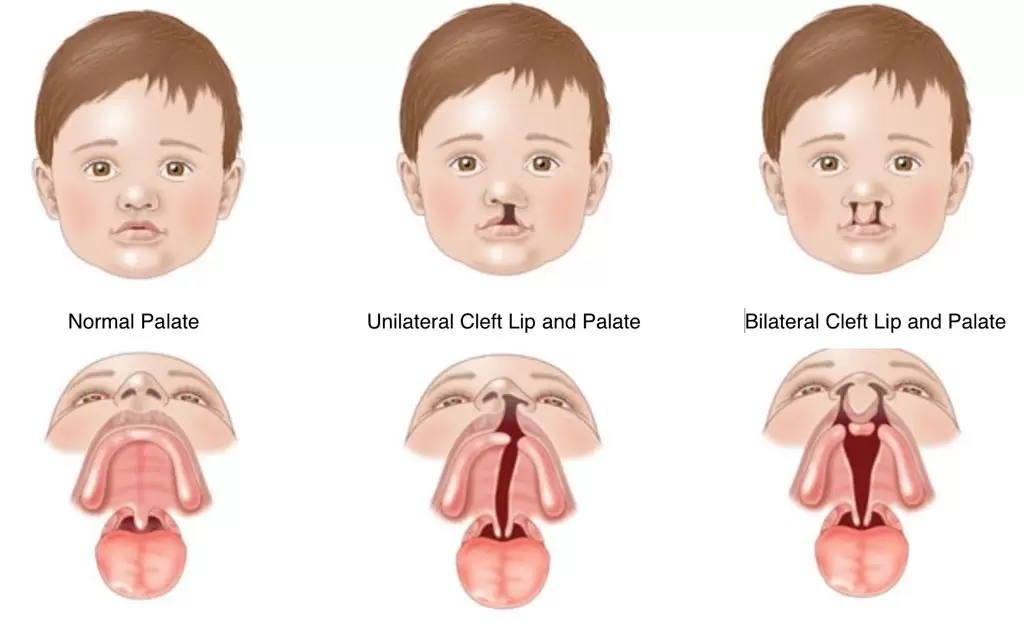
In most children with a cleft lip, it occurs unilaterally, while in a small number of cases, the cleft lip is bilateral. Due to the noticeable appearance of the newborn, we try to perform cleft lip surgery as soon as possible. In most cases, this surgery can be done at around three months of age. Cleft lip repair is performed under general anesthesia.
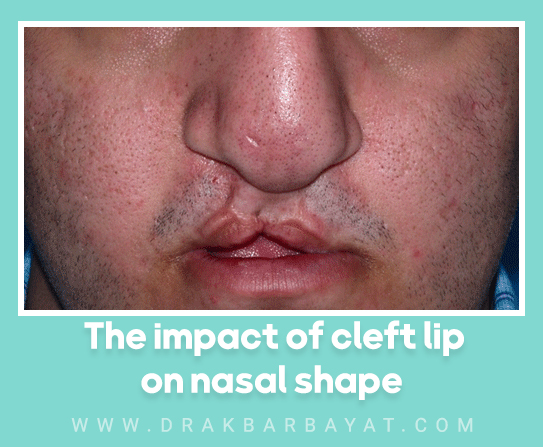
A cleft lip affects the growth of the nose, and as the child grows, it can cause asymmetry of the nostrils and a crooked appearance of the nose. Nasal reconstruction in individuals with a cleft lip is usually performed after the facial bones have fully matured.

Due to the defect in the continuity of the lip muscles in these children, the upper lip muscles are often weak and underdeveloped. This causes the upper lip to appear very thin in a frontal view and significantly retruded behind the lower lip in a profile view. Therefore, increasing the volume of the lip and the reconstructive surgeries performed in adulthood are very effective in improving the appearance and making the lips look more natural.
Changes in the tissues around the mouth in individuals with cleft lip
Normally, the muscle around the mouth forms a complete ring. This allows the mouth to close completely when the muscle contracts and enables the lips to pucker when the contraction is stronger. In cleft lip, because the muscle around the mouth is not a complete ring, contraction of this muscle not only fails to close the mouth completely, but also causes the edges of the cleft to separate further. This results in an unattractive appearance for the patient.
Effect of Cleft Lip on the Shape of the Nose
In cases where the cleft lip is complete and extends into the nasal cavity, the ends of the lip muscles on both sides of the cleft attach to the edges of the nostril. This causes the nostril to be pulled from both sides with each contraction of the lip muscle, making the nostril on the affected side larger and wider than the healthy side. In a complete cleft lip, the underlying bone is often absent or does not develop properly, which, as shown in the figure below, results in the nostril on the affected side being positioned further back compared to the healthy side.
Anomalies Associated with Cleft Lip
One of the most common anomalies seen alongside cleft lip is cleft palate (which is discussed in detail elsewhere). In these individuals, the palate does not form properly, leading to an abnormal connection between the nasal and oral cavities.
Fortunately, in newborns whose palate is intact and who only have a cleft lip, there is usually no significant problem with sucking or breastfeeding, and the baby can typically feed from the mother’s breast. In most cases, the shape and development of the teeth in individuals with a cleft lip are abnormal and require specific dental treatments.
In newborns with cleft lip, there is also a possibility of other anomalies in various parts of the body (such as the skull, eyes, heart, etc.). Therefore, the physician performing the initial examination must pay careful attention and conduct a thorough evaluation of the newborn.
Contact us via WhatsApp for offline consultation.
Indirect Complications of Cleft Lip
The psychological effects of this condition initially impact the parents. These effects vary depending on the cultural and social context of each family. If parents experience despair or hopelessness, neglect of the newborn or failure to follow up on treatment may worsen the complications of cleft lip in the child.Fortunately, these children have normal intelligence and, in terms of abilities and talents, do not differ from their peers. I have encountered many students who came for correction of even the smallest residual effects of a cleft lip. On the other hand, I have also seen cases where no treatment or repair was performed until the age of 23. With careful observation, it is often apparent that many of these individuals have other facial features that help mask the lip defect.
Fortunately, with today’s medical knowledge and technology, a person with a cleft lip can achieve facial aesthetics and live a completely normal life.
Appropriate Age for Cleft Lip Repair
Although cleft lip can be repaired with cosmetic surgery in the first days of life, it is generally recommended that the initial cleft lip repair be performed at around three months of age. At this age, the infant is in a better physical condition for undergoing lip surgery. During cleft lip repair, initial steps can also be taken to correct nasal deformities, which can improve the outcomes of subsequent surgeries.
Need for Revisions After Cleft Lip Repair
After cleft lip repair, the surgical site grows as the child develops, which can make the previous surgical effects more noticeable. In addition, nasal deformities caused by the cleft lip often become more pronounced with growth. Therefore, in most cases, revisions to the surgical site and the appearance of the nose are necessary after puberty. These revisions are usually performed in multiple stages, and individuals who follow the process carefully tend to achieve better results.
Contact us for consultation
Dr. Akbar Bayat
Board Certified in Facial Plastic Surgery from Europe